Ideas Have Sex
#173 - Why innovation compounds when ideas recombine

Hello friends, I hope you had a good week.
A few days ago I was listening to a podcast while running, and at some point, Marc Andreseen referred a line almost casually: “ideas have sex.”
The phrase stuck because it compressed several thoughts I have been circling around for a while into a single image. Innovation as recombination. Progress as ideas colliding and producing new ones. Ideas as inputs into other ideas, rather than finished artifacts.
As I kept listening, I started connecting this line with themes I had already written about. Talent density. Small teams outperforming large ones. Execution becoming cheaper and more abundant, while ideas become scarcer and more important. Across all of those topics, the same variable kept showing up: how quickly ideas meet, mix, and turn into something testable.
That sentence also shifted how I think about where innovation tends to concentrate. Breakthroughs appear in clusters. They show up in specific cities, labs, companies, or communities. People share tools, language, and partial solutions. The environment shapes the range of ideas you can combine.
That is the thread I want to pull on.
Ideas Have Sex
The phrase “ideas have sex” comes from a talk by Matt Ridley, and it is meant literally, not poetically.
Ridley’s point is that progress becomes cumulative only when ideas can recombine across different lineages. Early human technologies did not. For hundreds of thousands of years, tools barely changed. A hand axe was a hand axe for tens of thousands of generations. Knowledge moved vertically, from parent to child. Culture existed, but it did not accumulate.
What changed was exchange.
Once humans started exchanging goods, they also started exchanging ideas. Specialization followed. One group got better at one thing, another group at something else. Through trade, ideas stopped competing and started combining. The equivalent of sexual reproduction appeared in cultural evolution. Useful innovations no longer had to win against each other. They could merge.
This is why progress accelerates. Each new idea does not replace the previous one. It joins it. Tools become composites. Technologies become stacks. No single person understands the whole, but the system does.
From this perspective, innovation is not driven by intelligence, education, or even creativity in isolation. It is driven by the ability of ideas to travel, meet, and recombine through exchange. Where exchange is limited, progress slows or reverses. Where exchange is dense, technology compounds.
That is the mechanism behind accelerating returns. Not genius. Not planning. Recombination at scale.
Accelerating returns depend on recombination speed
Once you see innovation as recombination, accelerating returns become easier to explain.
Progress compounds because each new idea expands the set of possible next ideas. A tool enables a method. A method unlocks a product. A product generates data. That data feeds back into better tools. Outputs keep turning into inputs.
This is what people mean when they talk about accelerating returns. Technological progress feeds on itself. Not in a mystical way, but mechanically. The search space grows faster than linearly as building blocks accumulate.
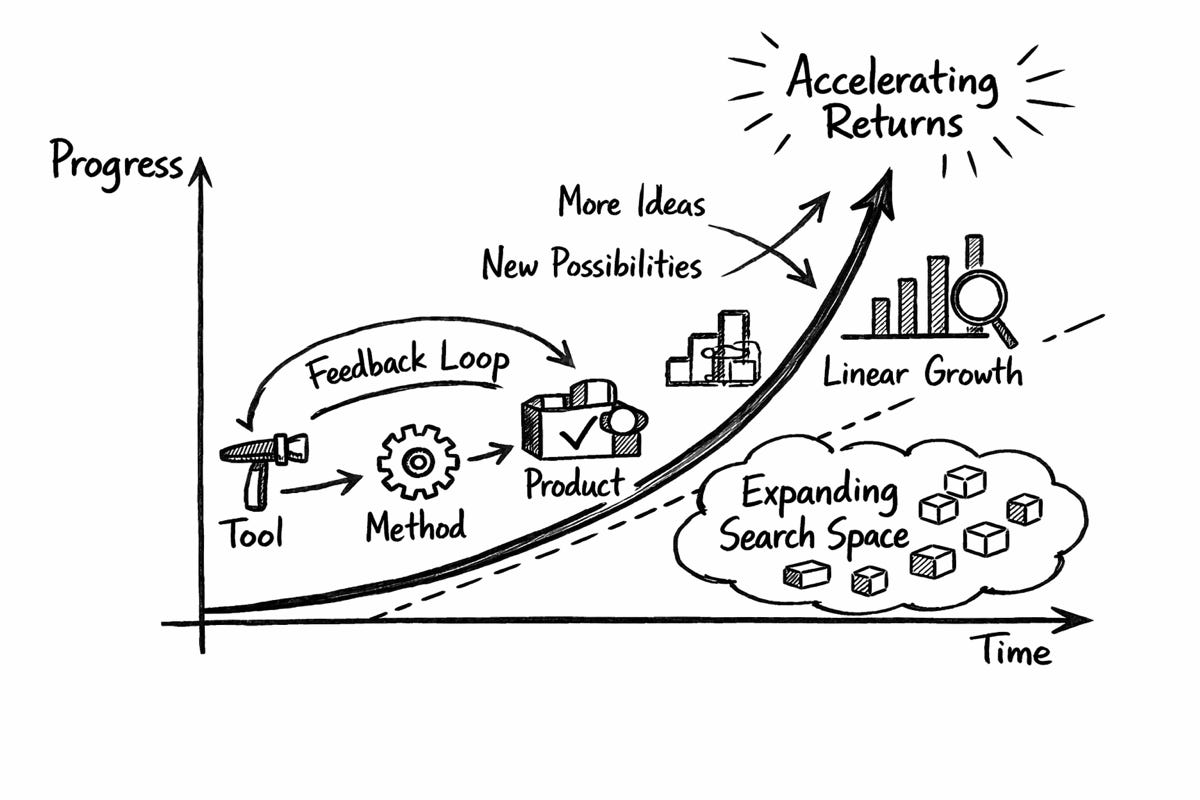
Execution becoming cheaper changes where the constraint sits. Testing ideas is easier. More ideas enter the system. The bottleneck moves upstream, toward selection and recombination. What matters is how fast useful ideas can be tried, filtered, and reused.
You can think of the loop like this:
ideas combine → something ships → reality pushes back → ideas recombine again.
Environments that shorten this loop move faster even when individual components are average. The advantage comes from cycle time, not heroics. Dense systems generate more attempts, more feedback, and more partial wins.
This also explains why progress often looks sudden. Long periods of quiet recombination stack up. Shared tools mature. Language converges. Then a small trigger pushes the system past a threshold and everything appears to move at once.
From this angle, innovation speed is a property of the system, not the individual. The rate of progress tracks how fast ideas can collide, get tested, and re-enter the pool. That rate varies sharply across environments.
Once recombination speed becomes the lens, it becomes clear why some places keep pulling ahead.
Talent density at ecosystem level
In the talent density post, I focused on teams. How coordination costs rise faster than output. How small, dense teams often outperform larger ones. That logic still holds.
At ecosystem level, talent density works through a different mechanism. The payoff comes from collision, not coordination.
Dense ecosystems succeed because they maximize the number of idea encounters per unit of time. Teams remain independent. Incentives stay local. Yet ideas travel freely across organizational boundaries. Tools, standards, and partial solutions circulate fast enough to be reused elsewhere.
The same logic explains Italian industrial districts. A textile firm in Prato or a furniture maker in Brianza does not innovate in isolation. Dyes, machinery tweaks, supplier techniques, and design ideas move informally across firms. Each company stays small. The ecosystem does the scaling.
This is the quiet advantage of Silicon Valley. Not capital abundance, not risk appetite, not even talent quality in isolation. The real edge is adjacency. Engineers move between companies. Founders reuse the same primitives. Ideas propagate sideways before they are fully formed. A solution discovered in one startup becomes a building block in another within months.
The same dynamic explains the strength of Italian industrial districts. Small firms, often family-owned, clustered geographically and cognitively. Deep specialization at firm level. High recombination at ecosystem level. Suppliers, competitors, and customers share knowledge informally. Innovation emerges from proximity rather than scale.
In both cases, headcount is a poor proxy for capability. A small team embedded in a dense ecosystem can outperform a much larger team operating in isolation. The advantage comes from networked competence, not internal completeness.
This also clarifies why attempts to copy these ecosystems often fail. You can replicate incentives, funding models, or governance structures. You cannot easily replicate the invisible wiring. The shared language. The fast trust. The habit of reuse. Density is cultural as much as numerical.
At this level, talent density stops being an HR concept and becomes a graph property. Who you are next to shapes what you can build. Ecosystems that compress distance between ideas compound faster, even when individual actors look average on paper.
That is the part most explanations miss.
AI shifts the bottleneck again
In an AI-rich world, ideas matter more, not less.
As execution costs fall, the value of turning an idea into something concrete collapses. Code, copy, prototypes, experiments, and variations are cheap to produce. What becomes scarce is not output, but direction.
When almost anything can be built, advantage shifts to the ability to decide which ideas are worth pursuing, how to combine them, and how fast to iterate on feedback. Selection moves from a background activity to the main constraint.
This changes how we should think about talent density. Dense environments have always worked by increasing exposure to good ideas and by shortening feedback loops. AI now proxies part of that function. It surfaces alternatives, stress-tests hypotheses, and accelerates iteration. It simulates some of the collision dynamics that used to require physical proximity.
But the proxy is incomplete.
AI can generate options and compress cycles, but it does not replace judgment. It cannot decide what matters, which combinations are meaningful, or when a direction deserves persistence. Those decisions still emerge from shared context, taste, and sustained interaction.
This is why tight environments continue to matter. Teams and ecosystems that already recombine ideas well gain leverage from AI because they can evaluate, integrate, and discard ideas faster. The technology amplifies existing density rather than compensating for its absence.
The practical consequence is subtle. AI lowers the minimum viable environment for experimentation, but it raises the ceiling for those operating inside dense networks. Small groups can now explore more, but only some environments can turn that exploration into compounding progress.
Execution keeps accelerating. Iteration becomes central. Idea assessment turns into the defining skill.
In that sense, AI does not flatten the landscape. It sharpens it. The places that already optimize for collisions now get them at machine speed.
Optimize for collisions
Once you look at innovation through this lens, a lot of familiar debates fade into the background.
The decisive variable is not team size, execution discipline, or individual talent in isolation. It is the rate at which ideas collide, get tested, and re-enter the pool. Put simply, what matters is how often ideas have sex 🙂
That does not require living in Silicon Valley or sitting inside a famous cluster. Most of us have experienced this dynamic firsthand. A long dinner with sharp people where one comment unlocks another. A conversation with someone you respect that keeps echoing days later. A great book that reframes a problem you thought you understood. A well-timed newsletter subscription that quietly rewires how you think about a topic. This one, for example. Hard to say which.
These moments work because they compress distance between ideas. They create temporary density. For a few hours, the environment gets richer, feedback gets faster, and partial thoughts become usable.
Seen this way, talent density is not an HR metric. It is a property of the graph you sit in. Who you talk to, what you read, what tools you use, and how often ideas cross paths shape outcomes as much as anything you execute internally.
One practical way I try to engineer this for myself is simple: I try to be the dumbest person in the room. I actively enjoy it. Being surrounded by people who are sharper, deeper, or further along than me means I’m constantly exposed to better ideas, better questions, and better combinations. For me, that feeling is not uncomfortable. It’s energizing.
Have a great weekend!
Giovanni