Nature vs Nurture
#199 - The most famous nurture story in non-fiction says the opposite of what we think

Hello friends, I hope you had a great week!
Anyone with more than one kid ends up making the same observation, usually out loud, usually to another parent: they came out of the same house and they’re nothing alike. Same parents, same rules, same dinner table, same holidays… and two completely different people. I’ve said this many times, probably too many.
I also had an explanation ready, and I admit I was quite attached to it. My second child grew up with an older sister already in the room. There was a model to copy, a model to push against, a role already taken. Nobody gets to be first at anything twice. So of course the second one turns out different: the environment the second kid is born into includes the first kid, and that’s a by definition a different environment. Tidy, reassuring, and completely a nurture story… which happens to be the story I’ve told about talent several times in this newsletter.
Then this weekend I bumped into a tweet from Matthew Berman saying that having a second kid shows you it’s 95% nature and 5% nurture, quoting Paul Graham arguing that we all have reasons to want to believe in nurture and none for wanting to believe the opposite.
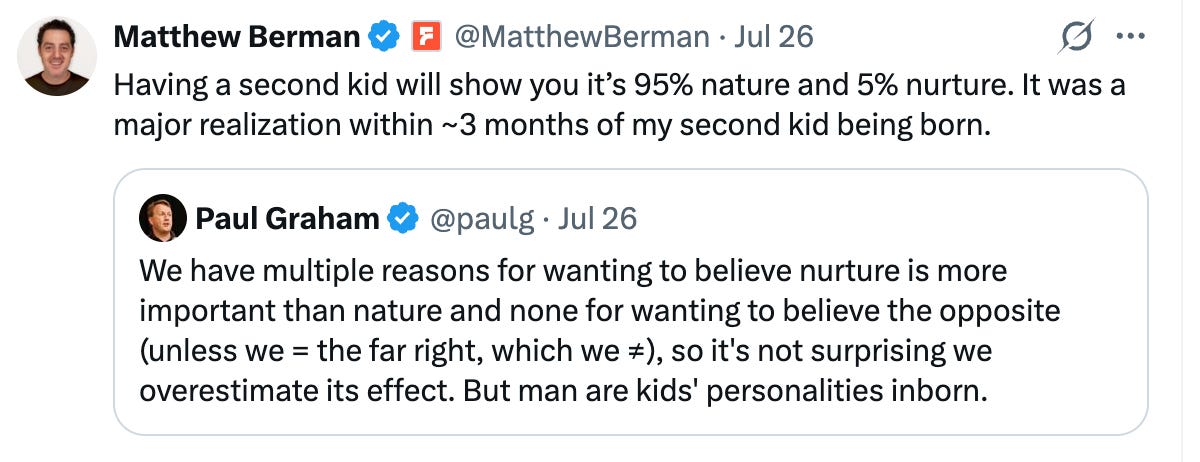
My first reaction was the easy one: he’s overreading a sample of two. I however ended up reflecting on it and took some time to see if I was too superficial and fast to conclusion. So I went and looked at the research, and honestly, a good part of my own side doesn’t survive it.
My theory was already tested
The problem with having an explanation you like is that somebody has usually already tested it.
The birth order idea isn’t something I came up with. Frank Sulloway built a whole book on it in 1996, Born to Rebel, arguing that firstborns end up defending the existing order because they inherit the parents’ attention and the incumbent position, while later-borns turn into rebels because they have to find a niche nobody has taken. It’s a great theory. It reads well. And it matches what every parent thinks they’re watching at their own kitchen table.
However, based on my reasearch, it falls apart when you enlarge the sample. Some researchers looked at more than 20,000 adults across Germany, the US and Britain and found no birth order effect at all on extraversion, emotional stability, agreeableness, conscientiousness or imagination. Others ran a similar test on 377,000 American high school students and got an average association between birth order and personality of 0.02, which is a polite way of writing zero.
I want to be careful, because overstating this is exactly the mistake I’m about to spend two thousand words complaining about. None of it says my kids aren’t different. None of it says that what happens between an older sister and a younger brother doesn’t matter in our house. It says something narrower and frankly more annoying: birth order doesn’t produce systematic personality differences across people. So whatever is making my two so unalike, the thing I reached for isn’t it.
And then there’s the part that stayed with me. Eric Turkheimer’s third law of behavior genetics says that a big share of the variation in human behavior is explained by neither genes nor families.
Siblings raised together really are wildly different, and after decades of looking, nobody can say why.
The case I have made five times
Before taking that tweet seriously I want to put my own side in its strongest form, because the nurture case isn’t soft or sentimental at all.
Based on most common measurements, IQ went up by roughly three points a decade across the developed world for most of the twentieth century. Whatever caused that, it wasn’t genes, because gene pools don’t move that fast.
Something in the environment (nutrition, schooling, or simply how abstract modern work has become) added close to a standard deviation to entire populations in two generations.
Then take the cleanest natural experiment anyone has run. Bruce Sacerdote studied Korean children adopted into American families through an agency that assigned them quasi-randomly, which removes the usual objection that better parents get better children to begin with. Transmission of years of schooling from the adoptive father came out at 0.114. From the biological father, 0.113.
The family that raised them passed on education just as strongly as the family that made them.
And if you want somebody who set out to prove it on purpose, there’s László Polgár, who announced in advance that genius could be manufactured and then raised three daughters on chess. Judit became the strongest female player in history.
That’s not a weak case. In one form or another, it’s the case I’ve been making on this blog for four years.
Then Ericsson broke
The centerpiece of that case, for me, was Anders Ericsson. I wrote a whole post about his book Peak back in October 2024, about deliberate practice, about how it’s not the hours but what you do inside them. I liked the idea partly because it keeps the door open. It tells you the ceiling isn’t fixed, you’re just practicing badly.
The problem is that I was victim of my own confirmation bias and had not realized it.
I did a bit more searching and found that:
In 2014 Brooke Macnamara, David Hambrick and Frederick Oswald ran a meta-analysis across every domain where deliberate practice had been studied. Practice explained 26% of the variance in performance in games, 21% in music, 18% in sports, 4% in education and under 1% in the professions. So practice matters, it matters a lot less than the framework claims, and it matters least in the domains that look most like real work.
Then in 2019 Macnamara and Megha Maitra went back to the study the whole thing rests on, Ericsson’s 1993 paper on violinists at the Berlin conservatory, and ran it again with a double blind procedure. The best violinists and the merely good ones showed no statistically significant difference in accumulated solo practice by age eighteen. Most of the best had actually practiced less than the average of the good group.
Ericsson disputed all of this until his death in 2020, and there’s a real argument about whether the replication measured the same thing he did. But the honest summary is that the strongest version of my position rests on a finding that didn’t replicate cleanly.
I published a post recommending deliberate practice five years after the study underneath it had failed to replicate, and the reason I didn’t know is that I never looked.
The hockey players are not the story I told
Which brings me to the story I’ve repeated most confidently, and which turns out to mean roughly the opposite of what I thought.
Gladwell opens the book Outliers with Canadian junior hockey. Roger Barnsley noticed in 1985 that the rosters were absurdly skewed by birth month: around 40% of elite players born in January, February or March, 30% in the second quarter, 20% in the third, 10% in the last. The cutoff for age groups falls on the first of January, so a boy born on the second is competing against boys up to eleven months younger. At eight years old that’s a lot of body. He gets picked for the better team, gets the better coach, plays more games against better opponents, and eleven months of pure accident compounds into a career. A study in 2023 found the same 40/10 split, forty years later.
Gladwell reads this as proof that practice makes the player, and I’ve told it that way myself. But when you again, apparently there’s a second finding that doesn’t appear in the book.
The effect reverses at the top. Among the players who actually reach the NHL, the ones born late in the year score more points, earn higher salaries and last longer. If the January advantage were real ability, that couldn’t happen. What it means is that the filter was selecting for birth month, calling the result talent, and then handing over the training that made the label come true. The boys born in December who got through had to be genuinely better to survive a system built against them, and once the physical gap closes in adulthood, it shows.
And the same filter runs well outside sport. Kids who are youngest in their school year are notably more likely to be diagnosed with ADHD than their oldest classmates, which is to say we might be medicating a birthday.
So the most famous nurture story in popular non-fiction turns out to be a story about selection.
The case I have never made
Now the other side, which honestly I have never given a fair hearing here.
Turkheimer’s first two laws, published in 2000 and still standing, are that all human behavioral traits are heritable, and that the effect of being raised in the same family is smaller than the effect of genes. Smaller, though not zero. For the standard personality traits, heritability lands somewhere around 40 to 50%, and the shared family environment (the part that makes siblings resemble each other) sits close to zero.
That second number is the one that should bother anyone with children. Read carefully, it says something narrower than parents being irrelevant. Whatever parents do, the effect doesn’t show up as siblings resembling each other.
Then there’s the finding that surprises almost everyone, including me, and which I had to read three or four times before I accepted it. The heritability of intelligence goes up with age. In young children it sits around 20 or 30%, and by adulthood it’s somewhere between 60 and 80, while the influence of the family you grew up in fades towards nothing. We all assume the opposite, that we start as raw genetic material and get gradually shaped by life. Measured across a population, it runs the other way.
This is by the way a good explanation of how we “all turn into our uncle” (misquoting a famous 90s Italian B-movie, “me pari tu zio”).
Genes do not cause outcomes, they cause environments
The model that reconciles most of this was published back in 2001 by William Dickens and James Flynn, and it was written to solve exactly the paradox I’d been circling around: how can intelligence be highly heritable and also rise 30% in a century?
Their answer is that genes and environment aren’t two separate inputs you weigh against each other. They’re coupled:
A small initial advantage, whatever its origin, gets you selected into an environment that rewards it.
That environment develops the advantage further, which gets you selected into a better one, and so on.
The multiplier does the work, and the original edge can be tiny, or as the hockey rosters show, completely arbitrary.
This thesis predicts that heritability studies will produce very large numbers, because they charge the whole compounded effect back to the initial cause, which is the only thing they can observe at the start. The kid who reads slightly better at six gets read to more, gets handed harder books, gets put in the good group, and thirty years later everything built on top of that gets scored to the gene.
It also settles the thing that had been nagging me about Ericsson’s violinists. Of course they showed no practice gap. They were all at the Berlin conservatory. Every one of them had already been selected, and selection had already equalized the practice. The more filtered the pool you’re looking at, the more the remaining differences look innate, because everything teachable has already been taught to everyone in the room. That’s a fact about the pool, not about the people in it.
And the multiplier doesn’t stop at one lifetime. Guglielmo Barone and Sauro Mocetti took the Florentine tax survey of 1427, which is unusually detailed, matched around eight hundred surnames to the people carrying them today, and found that families near the top six centuries ago are still measurably above average now, with the persistence strongest for wealth and for membership of the elite professions. You can read that as heritable competence. You can also read it as a multiplier that’s been running since before the Medici, made of capital, contacts and a surname that opens doors. Nothing in the data separates the two, and honestly I’m not sure anything could.
What I keep coming back to is how consistently we hand the credit to whatever happens to be visible… we are fooled by randomness (quoting one of my favorite books)!
I explained my kids with birth order, because birth order can be seen. Scouts explained hockey players with size, because size is obvious at eight. Gladwell explained mastery with hours, because hours can be counted. Berman explained his second child with genes, because the difference showed up before he’d done any parenting worth the name. Every one of us reached for the legible variable and handed it the whole story.
Which leaves me somewhere less comfortable than where I started. I don’t know why my two are so different, it turns out nobody else does either, and the theory I was fond of isn’t the answer. What I do know is that somewhere early on a small difference met a system that noticed it, and the system did most of the rest.
Have a fantastic weekend!
Giovanni
Ah, such an intesting topic! I recommend Matt Ridley Nature via Nurture, if you haven't read it. He adds colour to the research you described. For instance, on twins:
"For nearly all measures of personality, heritability is high in Western society: identical twins raised apart are much more similar than fraternal twins raised apart. The difference between one individual and another owes more to differences in their genes than factors in their family background."
"Paradoxically, the more equal we make society, [..] the more genes will matter."
Some of it is tough to read as a parent: we want our kids to have equally good "cards hand", but they were dealt one at birth and that's what they are going to have, (almost) regardless of how much effort you poor in afterwards.