The Last Useful Job
#169 - The Power of The Fixer

Hello friends, Happy New Year!!
I came across an image that made me laugh because it was very accurate. You know the type. It’s funny for five seconds, then it sticks because it names something everyone recognizes and nobody has a clean label for.
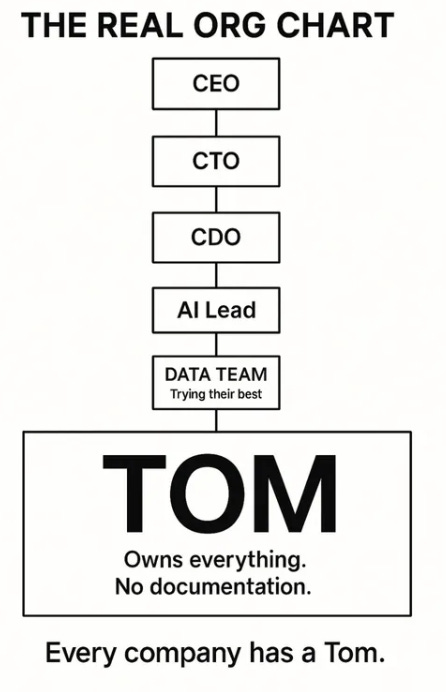
This post is about that label: the fixer.
Most teams spend a lot of time talking about vision, strategy, and talent density. All real. Day-to-day execution still depends on a different kind of leverage: the person who stabilizes the system. The one who closes loops, unblocks the stuck work, cleans up the messy handoff, and turns vague intent into something that actually happens. Their output is reliability.
That contribution is consistently mispriced. It’s hard to measure, hard to narrate, and easy to miss when it works. A crisis avoided does not show up as a win in a weekly update. A process that stops leaking does not look like a breakthrough. The system just feels calmer. People start saying “we’re running better lately” without being able to point to why.
I want to write this as a tribute and a provocation. A tribute to the people who keep things working. A provocation about incentives, status, and what we end up rewarding when we say we value execution.
The fixer, defined
A fixer is someone whose default mode is: “this needs to work.”
They show up when the system is fuzzy. The goals are half-clear, the owners are “kind of,” and the handoffs leak. They take that mess and turn it into something with edges. They ask the annoying questions early. Who decides. What is the deadline. What is in scope. What breaks if we ship this. What is the fallback.
They rarely do this with grand gestures. Fixing is mostly small moves that compound. Writing the one-page that aligns six people who thought they were aligned. Setting a meeting with the two teams that keep missing each other. Getting the legal review started before it becomes a blocker. Catching the quiet dependency that will explode on Friday afternoon. Turning a vague “we should” into a sequence of decisions that can actually be made.
The output of a fixer is reliability. Reliability has a weird property: it disappears into the baseline. When a system becomes dependable, people stop noticing the work required to keep it that way. The absence of incidents becomes “normal.” The process starts feeling “obvious.” The team stops talking about execution and starts talking about what to build next. That is the point, and it is also why fixers get under-credited.
Fixers also tend to carry a specific kind of burden: they get handed problems that lack clean ownership. “Can you take a look?” is the start of many unpaid jobs. In healthy systems, that request turns into a clear owner and a closed loop. In unhealthy systems, it turns into a shadow org chart where the fixer owns everything important and very little is written down.
This matters beyond work. Every family has version of this role. Every friend group has it. Some people default to holding the system together because they cannot tolerate drift. They make plans real. They prevent small issues from becoming fights. They handle logistics that nobody thinks about until it’s late.
Hint: my wife is the fixer in my family, and that’s actually why I started framing these considerations in a post during the holidays… everything just works and I often find myself repeating “how did you anticipate this?”.
That is the fixer archetype: a competence that scales systems, even when the system refuses to name it.
Why fixers stay undervalued
Fixer work has a structural problem: it is harder to see than the work it enables.
Most organizations reward outputs that are legible. A shipped feature, a closed deal, a model that beats a benchmark, a keynote that lands. Fixing often produces a different kind of outcome: fewer incidents, fewer escalations, fewer surprises, fewer late nights. The system feels calmer. That “calm” rarely maps cleanly to a promotion packet.
Credit assignment breaks quickly in messy environments. When five things could have caused a failure and one person quietly prevented three of them, nobody can prove the counterfactual. The absence of a disaster is a weak story, even when it was the point. It also does not travel well. You can show a dashboard with growth, you cannot show the meeting that prevented the wrong decision from becoming policy.
There’s also a narrative bias. Fixers operate in the details: dependencies, timelines, stakeholders, edge cases, coordination costs. Details sound operational. Operational sounds replaceable. Many orgs say they value execution, then build status systems that treat execution as hygiene. Hygiene matters most when it’s missing.
Fixing is also sticky. Once you become the person who can resolve ambiguity fast, the system routes more ambiguity to you. You end up owning the hard parts because you are dependable, and the reward for being dependable is often more dependence. The work expands, the visibility stays flat.
Outside work, it’s similar. The person who books, coordinates, reminds, mediates, and keeps things moving becomes “the organized one.” It reads like personality, even when it is effort. The group enjoys the stability and forgets the cost.
None of this is malicious. It is a predictable outcome of incentives that privilege clean ownership stories and visible artifacts. The result is consistent: teams talk about excellence, then under-invest in the people who make excellence repeatable.
The hidden debt when nobody fixes
Fixers rarely get credit because the value shows up as “nothing broke.” The cost of not having them shows up everywhere, slowly, and it spreads.
Every shared system accumulates debt when decisions and handoffs stay fuzzy. Call it coordination debt, decision debt, relationship debt, operational debt. The label matters less than the pattern: small unresolved issues compound into expensive friction.
Coordination debt is what happens when ownership is unclear and dependencies stay implicit. Two teams assume the other one is handling the edge case. A family assumes someone booked the tickets. A group of friends assumes “we’ll figure it out.” The work still gets done, just later, with more stress, and usually by the same person who cannot tolerate drift.
Decision debt is what happens when trade-offs stay unmade. People keep options open because committing feels risky. That choice carries a cost. Unmade decisions turn into rework, churn, and last-minute escalation. You can run for a while on “we’ll decide later.” Eventually “later” becomes the deadline.
Relationship debt is what happens when small misalignments never get resolved. A misunderstanding sits in the background. The next conflict loads on top of it. A fixer often does the unglamorous work of clearing the air early, translating intent, resetting expectations, and closing loops with dignity.
Operational debt is what happens when the system relies on memory and heroics. The knowledge lives in one person’s head. The process works because someone knows the unofficial steps. When the system depends on tribal knowledge, it becomes fragile by design. People call it speed. It behaves like single points of failure.
This is not a “work problem.” It is a systems problem. Schools, households, communities, and teams all run on the same mechanics: decisions, handoffs, norms, and follow-through. Fixers quietly pay the interest on debt so others can focus on the visible work. When they are missing, everyone pays, just in smaller daily taxes that feel normal until they suddenly don’t.
Where fixers show up
Fixers rarely sit in one neat role. They sit at the seams. Anywhere work crosses teams, priorities, or incentives, the system creates gaps, and someone either closes them or they stay open.
In companies, you often find fixers in “unsexy” titles. Program owners who make cross-team commitments real. Ops people who turn intent into repeatable execution. Product and engineering leads who spend half their time on alignment and half on unblocking. People in finance, legal, and people ops who prevent avoidable mistakes and translate constraints into workable paths. Support leaders who treat recurring issues as design problems. Sometimes they are managers, sometimes they are ICs. The common thread is behavioral, not hierarchical.
Fixers also show up inside high-talent teams. Talent density does not remove coordination. It increases it. When the pace is high and the surface area is large, a lot of the “real work” becomes sequencing, prioritization, risk reduction, and decision hygiene. The fixer is the person who will do that work without needing to be asked twice.
Outside work, the archetype is even clearer because the org chart is informal. In families, it’s the person who keeps the calendar coherent, anticipates pinch points, and prevents logistics from turning into stress. In friend groups, it’s the one who actually books the restaurant, reconciles preferences, and makes the plan happen. In communities, it’s the organizer who deals with permits, constraints, budgets, and the boring details that separate “great idea” from “it happened.”
This is why fixers can be easy to misread. Their work looks like personality. “They’re just organized.” “They’re naturally responsible.” In reality it’s competence applied repeatedly to messy systems.
Fixers also tend to develop an internal standard: they feel discomfort when things drift. They notice the loose end that others ignore. They pay the small cost today to avoid the large cost tomorrow. That instinct is valuable, and it can also become a trap if the system learns to rely on it without acknowledging it.
If you want to find the fixer, look for the person who makes promises concrete and makes chaos less contagious.
Be Useful
Schwarzenegger’s autobiography is one of the most surprising books I’ve read in the past few years. I went into it expecting a Hollywood nostalgia trip, Terminator, muscles, movie sets, that whole universe. The actual story is far bigger. It starts in post-war Austria with a hard, veteran father, then jumps to a kid who leaves early, lands in the US, and rides the strange magic of 1970s Venice Beach. He is suddenly in a scene that feels almost unreal on paper, training and hustling around people who defined that era, then brushing shoulders with the cultural and celebrity ecosystem that revolved around it. From there he becomes a global movie star, marries into the Kennedy family, and later moves into politics, including working with George H. W. Bush and eventually becoming governor of California. It reads like several lives stitched together.
What stuck with me most, though, was not the celebrity trajectory. It was a small recurring motto he credits to his father: “be useful.” It’s a simple phrase with a lot of weight. It hit me because it describes what I’ve watched my own parents do for decades, even without using that label. My mom and dad have always operated with this principle, even if they were not calling it like this.
My dad, especially, was the biggest fixer I’ve ever seen in action: the person who notices what’s broken, steps in without drama, and leaves the system better than he found it.
Schwarzenegger later turns “be useful” into a whole operating principle, and eventually an entire book. The reason it resonates is that usefulness is one of the few traits that survives any context shift. Titles change, industries change, tools change. The ability to make things work, to reduce friction, to close loops, to take responsibility for outcomes that don’t have clean ownership, that is durable. It’s also regularly under-rewarded because it produces stability, and stability becomes invisible fast.
In an AI-heavy world, this becomes even more valuable. AI makes it easier to produce output. It does not automatically make systems work. When everyone can generate code, docs, analyses, and options at low cost, the bottleneck moves to integration: choosing, sequencing, aligning, and shipping without breaking the rest of the machine. More surface area creates more seams. More automation creates more edge cases. Faster iteration increases the chance that small inconsistencies compound into real failures.
That shifts the premium toward the people who can keep the system coherent.
Fixers translate abundance into reliability.
They connect tools to reality: permissions, data quality, handoffs, incentives, customer impact, and the messy human parts that don’t disappear because a model got better. AI will reward the people who can turn a flood of possible work into a smaller set of correct work.
What I like most about “be useful” is that it’s quietly altruistic. It’s competence pointed outward. It’s choosing to make other people’s lives easier, even when there’s no applause attached. It’s also a virtue that travels well. Every culture has some version of it, and most serious philosophies put it near the center: show up for others, reduce suffering where you can, do your part, carry weight when it’s needed.
That’s probably why the fixer archetype resonates beyond work. We all remember the people who made the system hold together when it could have drifted. We also remember how rare it feels to be around someone who is both capable and genuinely helpful, without turning it into a performance.
Always be useful, and enjoy the weekend!
Giovanni
Great post. And adding Schwartznegger's bio to my reading list.