Unlocking Career Potential
#53 - The Magic Loop for Career Development

Hello friends, I hope you had a great week!
Today’s post is a combination of a newsletter I read a few weeks ago, and a video that I stumbled upon. The things are totally unrelated but this happens to me quite often: since I started writing this newsletter, when I decide a topic I want to talk about I notice content from many directions that could tangentially be relevant and start collecting links (probably because my phone is listening to me, as I wrote in a recent post?!!).
The video that inspired me is the following pill of wisdom from President Obama:
The simple advice Obama gives to someone looking for career advice is: learn how to get stuff done. This sounds superficial at first, but it actually has a very deep meaning. As the former President lays out very eloquently it is easy to find people that can spot problems and highlight things that are not working. It is a lot less common, yet a lot more useful, to find people coming up with solutions and the will to solve problems.
One of my first managers, early in my career, used to repeat as a mantra (most of the time jokingly): “If you have a problem, and not a solution, you’re part of the problem!”
And that’s where it interjects something I read recently called “The Magic Loop for Career Advancement”.
This concept was originally defined by an Amazon VP (the former leader of Twitch) and I find it super interesting. As you might have heard in Amazon we’re a bit obsessed with this concept of “flywheels” (or positive reinforcement cycles), and Ethan Evans designed this one:
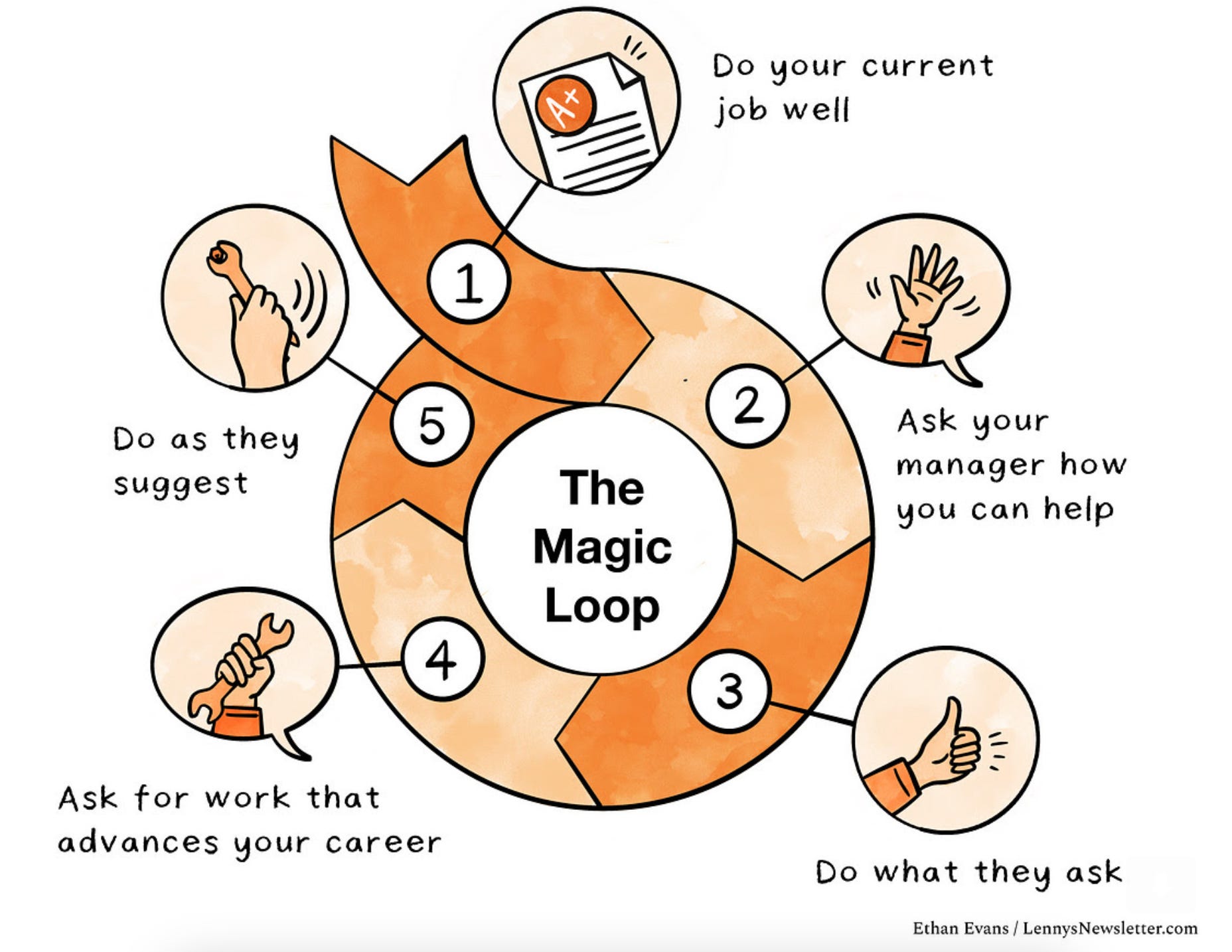
The reason why I really liked this approach is that I really subscribe to it. I had never seen it until a few weeks ago, but it actually sums up all my experience on career progression and what things I have seen working as team member, peer or manager. It’s one of those cases where I see someone formulating very well something I also had in mind, but that I had never put down so crisply and clearly!
Before I jump into the Magic Loop and describe what it means and why I think this is very relevant for career advice I have a final caveat, linking with yet another non-related piece of content. I recently listened to a podcast where Sam Altman (the founder of OpenAI, one of the most brilliant people in the world imho) said “I know that humans love advice, we all want someone to tell us what to do. But truth is that my biggest advice is ‘don’t listen to any advice!’. Usually career progressions are so personal, and highly serendipitous that it is impossible for an external to give you any guidance”. I 110% concur with that and that’s why.. we’re going to dive deeper into this framework, rather than advice, on what you can do to optimize the chances of success in your career!
The Essence of the Magic Loop
The Magic Loop is a career advancement strategy that has proven its effectiveness across various industries and roles. Developed by Ethan Evans, this method focuses on a simple yet powerful loop of five steps that can help you grow both personally and professionally. The core idea is to be proactive in your career by consistently offering help to your manager and taking on additional responsibilities. The first step of this approach aligns well with the philosophy of "being useful," a principle that is key to another non-related piece of content I love: Arnold Schwarzenegger’s biography (I always say that this was one of the best surprises books, I had super low expectations but ended up loving it!). Schwarzenegger's father instilled in him the value of usefulness, advising him to find ways to be helpful to those around him, regardless of the task at hand. This principle has guided Schwarzenegger throughout his diverse career, from bodybuilding and acting to politics. Similarly, the Magic Loop encourages you to be useful in your professional environment, thereby creating a mutually beneficial relationship with your manager and accelerating your career growth.
The Five Steps of the Magic Loop
Navigating career growth can often feel like a maze with no clear path. The Magic Loop simplifies this journey into five actionable steps. These steps are not just tasks to check off; they are ongoing practices that evolve as you grow in your role and responsibilities.
1. Do Your Current Job Well
The first step might seem obvious, but it's foundational to the entire process. Excelling in your current role is crucial because it establishes your reputation as a competent and reliable team member. Your performance sets the stage for future opportunities and serves as a barometer for your manager's trust in you.
But how do you know if you're doing well? Regular check-ins with your manager are essential. Choose a quiet moment, free from the chaos of looming deadlines or crises, to ask for feedback. Frame it as a non-threatening request, like, "I want to ensure I'm contributing effectively. Could you share how you feel I'm doing?" Accept the feedback graciously, whether it's positive or negative, and use it as a guide for improvement.
Remember, the goal is not just to meet expectations but to exceed them. This will not only make you a valuable asset to your team but also prepare you for the next steps in the Magic Loop. In line with Arnold Schwarzenegger's philosophy of "being useful, aim to be helpful and useful in every interaction. This principle of usefulness can serve as a guiding light, making you not just an employee who does their job well, but one who actively seeks ways to contribute positively to the team and organization.
2. Ask Your Manager How You Can Help
Once you've solidified your reputation as a reliable and competent employee by excelling in your current role, the next logical step is to proactively offer your help to your manager. This is where the Magic Loop really starts to gain momentum. Managers, often burdened with an array of tasks and responsibilities, usually welcome an offer of assistance.
Timing and approach are key when offering to help. Choose a moment when your manager isn't swamped with other pressing issues. Frame your offer in a way that leaves room for them to think it over. For instance, you could say, "Is there anything more I can do to assist you? I can check back in a week if now's not a good time."
One effective strategy to stand out is to volunteer for tasks that come up during meetings. When a new project or task is discussed, and you notice your manager pondering who to assign it to, seize the opportunity to step up. This not only alleviates your manager's workload but also positions you as a proactive and engaged team member in the eyes of your peers and superiors.
3. Do What You Are Asked
After you've offered to help and your manager has assigned you a task, the next step is to execute it to the best of your ability. This might sound straightforward, but it's a crucial part of the Magic Loop. Successfully completing the task reinforces your reputation as a reliable team member and keps building trust with your manager.
It's natural to hope for high-profile or exciting tasks, but managers often need help with more operational or mundane tasks. In the tech world, for example, this could mean tasks like migrating servers, applying patches, or fixing bugs. While these tasks may not be glamorous, they are essential for the smooth running of any operation.
If you find that the task is beyond your current skill set, it's crucial to communicate this to your manager. However, frame it in a way that shows your willingness to learn and grow. For example, you could say, "I'm eager to help with this, but I'm not experienced in [specific area]. Could you point me to some resources or offer some guidance?"
Completing the task successfully and on time will not only help you meet the first step of doing your current job well but also set the stage for the next steps in the Magic Loop, where you can start aligning your tasks with your career goals.
4. Align Your Help with Your Career Goals
Once you've proven your reliability and willingness to contribute, the fourth step in the Magic Loop allows you to start aligning your efforts with your career aspirations. This is the point where you can begin to steer the type of tasks you take on in a direction that not only benefits your manager and team but also furthers your own professional development.
Note that this step is at the end of the loop, whereas I have often seen people put this first and I personally do not believe that works well. Show how you are useful, and then start thinking about your agenda!
To move to this step, you need to have a clear idea of your career goals. Whether it's learning a new skill, taking on more responsibilities, or aiming for a promotion, having a defined objective will guide your conversation with your manager. The key here is to frame your request in a way that shows mutual benefit. For instance, you could say, "I've been interested in learning more about [specific skill or area]. Is there a way I could assist you while also gaining experience in this field?"
This step is a win-win situation. Your manager gets the help they need, and you get to develop skills or take on responsibilities that are aligned with your career goals. It's a way to demonstrate that you're not just thinking about what you can get from your job, but also what you can give back, thereby creating a cycle of mutual benefit.
5. Repeat the Loop
The final step in the Magic Loop is perhaps the most straightforward yet the most crucial: repetition. The Magic Loop is not a one-time process but an ongoing cycle that you should revisit throughout your career. This step ensures that you continually adapt to new challenges, update your goals, and maintain a strong relationship with your manager.
Where you "repeat" in the loop can vary. Sometimes you may go back to step four to take on tasks that align with new or updated career goals. Other times, you might need to revisit step one to ensure you're still excelling in your current role, especially if you've taken on new responsibilities.
The repetition is not just about doing the same things over and over but about refining your approach each time you go through the loop. It's about maintaining a dynamic relationship with your manager, one that evolves as you both grow and as the needs of the organization change.
By consistently applying the Magic Loop, you'll find that you're not only advancing in your career but also contributing positively to your team and organization. It's a strategy that fosters both personal growth and professional development, setting you on a path for long-term success.
Advanced Forms of the Magic Loop
After mastering the basic steps of the Magic Loop, you can take your career advancement to the next level by incorporating advanced techniques. These methods are designed to deepen your relationship with your manager and further accelerate your career growth.
1. Suggest Your Own Ideas
Once you've built a collaborative relationship with your manager, you can start to take more initiative by suggesting your own ideas for projects or improvements. Instead of just asking what needs to be done, you can propose solutions to problems you've identified. For example, you could say, "I noticed we often run late on projects due to overlooked vacation schedules. What if I implement a step in our planning process to account for this?"
This proactive approach not only solves problems but also positions you as an innovative and forward-thinking team member. It's a way to evolve from being merely helpful to being a driving force within your team.
2. Just Do It
As your relationship with your manager strengthens and trust is built, you can begin to take action without always seeking prior approval. This level of autonomy is the ultimate goal and reflects a mature, collaborative relationship with your manager. For instance, if you identify a process that can be optimized, you can go ahead and make the necessary changes, informing your manager afterward.
This approach shows that you're not just a task-taker but a problem-solver who can operate independently. It's a sign that you've moved beyond the basic steps of the Magic Loop and are now a valuable asset who contributes proactively to the team's success.
The Long Game in Career Advancement
Navigating the labyrinth of career advancement can be daunting, and hopefully the Magic Loop offers a structured and effective approach to not only grow in your current role but also to set the stage for long-term success. I also wanted to add two more principles that I've found to be invaluable in my own career journey:
Career is a Marathon, Not a Sprint
It's easy to get caught up in the rush for immediate gains, be it a promotion or a salary hike. However, career growth is a long-term endeavor. The Magic Loop is not about quick wins; it's about consistent and sustainable growth. Always keep your long-term goals in mind and don't sacrifice them for short-term objectives.
Focus on Controllable Inputs, Not Outputs
While it's natural to aim for tangible outcomes like promotions or salary increases, it's crucial to focus on what you can control: doing a good job. Outputs are often the result of various factors, many of which are beyond your control. On the other hand, your performance, your willingness to learn, and your attitude are all controllable inputs. Concentrate your energy here, rather than getting lost in the quagmire of office politics or constant benchmarking with peers. I have literally never seen anyone saying 'I love corporate politics' so avoid focusing and getting lost in it!
Incorporating these principles can provide a comprehensive strategy for career advancement. It's not just about climbing the corporate ladder but about personal and professional development, about becoming not just a better employee but a better version of yourself.
Do you have any other framework you have found useful in career development? Alfonso shared a really interesting 4-posts series here, I really enjoyed it and found very inspiring the Formula of Satisfaction at work.
Wish you all a great weekend!
Giovanni
Great newsletter this week! I really enjoyed it. Also I found very useful when you mentioned the books that inspired you (e.g. this time Arnold’s biography) - Most of the time I buy and read them. Thanks Gio
+1 on every single advice of this article! I will share this with my team as a perfect guide to career growth and, more importantly, job and personal satisfaction.